Weekly Forecasts 15/2026
U.S. inflation explodes, and a geopolitical risk forecast for Europe

Contents:
Geopolitical risk forecasts for Europe (by Sakari Linden).
U.S. inflation exploded in March.
A near-worst-case scenario for U.S. inflation.
This week we’ll concentrate on U.S. inflation and provide you with a “near-worst-case” scenario for it, which at the time of writing looks scarily likely. However, we begin with a geopolitical risk forecast of Europe by Sakari Linden.
Sakari is a Belgium-based geopolitical analyst who is a former political advisor in the European Parliament. He outlines the worrying trajectory Europe is on, concerning the stance of European leaders towards Russia. He argues that, at the current trajectory, a war between Europe and Russia looks inevitable. Moreover, he argues that, again, at its current trajectory, the war would erupt between this year and 2028.
Then we move into U.S. inflation. There was something of an explosion in the U.S. Consumer Price Index (CPI) in March. It was actually so big that even our supply chain collapse scenario was unable to capture it fully.
The “error” in our previous scenario forecasts for U.S. inflation was that we did not combine the oil crisis with the supply chain collapse. We also did not correctly model the severity of the current shock. In this report, we set out to fix these issues.
Our modeling implies that in the case of an extended closure of the Strait of Hormuz and the “hot war” restarting and continuing for a few more weeks, U.S. inflation would reach double digits by September. At the end of the forecasting period (March 2027), U.S. inflation would break a record with a 17% annual change in the CPI.
Tuomas
Geopolitical Risk Forecast: Europe slides towards a continental war
Ukraine has been in crisis since February 2014. The conflict escalated after Russia invaded Ukraine on February 24, 2022, after Ukraine’s armed forces started a massive attack against rebels of two Russian-speaking regions of Ukraine, Donetsk and Lugansk, from February 16, 2022, onwards. Currently, in April 2026, Russian troops occupy about 20% of Ukraine.
Geopolitics can be used in order to explain past events and to forecast future developments. Both the western powers and Russia have good reasons not to give up their grip on Ukraine. On the one hand, Anglo-American theories of Eurasian geopolitics put emphasis on the containment of Russia, the primordial interest of the US to stop a coalition between Germany and Russia, and the goal to isolate Russia from Eastern Europe.
On the other hand, the Northern European Plain was historically used by European powers to conquer Russia. This historical fact has affected deeply Russian way of thinking of its security. It also explains Russia’s determination to act in its western neighborhood.
Russian leaders have set their hopes in the “Spirit of Alaska” i.e. potential for US-Russian rapprochement after presidents Trump and Putin met each other on August 15, 2025 in Anchorage, Alaska. Unfortunately, historical patterns and current geopolitical dynamics do not favor a peaceful solution to the conflict.
The problem from the point of view of the “Spirit of Alaska” is that the question is not only about Ukraine. There is a much bigger battle going on at the world level between the unipolar world model based on the hegemony of the United States, on the one hand, and the emerging multipolar world model promoted mainly by China and Russia, on the other. The US has started to defend aggressively its hegemony against its challengers by launching wars in Venezuela and Iran and targeting China and Russia’s maritime energy routes.
The status quo does not satisfy anyone on the battlefield. The EU cannot admit a defeat in the war that has already become one of its own. The defeat would result in the EU losing face and authority in front of its member states, which would release the centrifugal forces of the EU system and thus start the break-up process of the EU. Russia, for its part, is seeking better protected borders against the western threat, which the current frontline does not provide. Russia has an incentive to reach for the Dnieper River and eventually for Odessa, which would enable Russia to cut Ukraine off from the Black Sea coastline.
While it is true that the US does not have sufficient resources to wage war in all three global theaters of war, in Europe, the Middle East, and East Asia, anymore, it does not mean that the US would be willing to decrease the level of pressure against Russia. In the new burden-sharing model between the US and the EU, the EU invests significantly in its military capabilities, but in a way that implements the geopolitical goals of the United States. The EU’s role in this new equation is to exert military, economic, and political pressure on Russia and to strive to bring Ukraine into the sphere of influence of the Collective West.
The presence of continued pressure can be seen in Ukraine too. Rather than finding a peaceful solution to the conflict, the Western powers have preferred escalation in Ukraine. Examples of escalation on the Western powers’ part are Ukraine’s Western-backed drone attacks against Russia’s strategic bombers in June 2025, as well as against President Putin’s residence in December 2025.
Recently, Ukraine has used airspaces of the Baltic States to attack Russian targets. The UK is also threatening to start to seize Russian ships at the seas. These are the most potential ways that could escalate the conflict and expand it into a continental war between the EU and Russia.
Moreover, the recent victory of the Tisza party in the Hungarian elections will likely remove obstacles from EU’s further financial support to Ukraine, as well as from Ukraine’s EU membership, which could escalate the war in Ukraine.
Ukraine is at the center of great power interests to such an extent that restoration of peace seems highly unlikely. The US fights for its superpower status, and the EU needs outside enemies in order to preserve its unity, to avoid break-up, and to further its common defense plans. Therefore, a direct war between Russia and the EU looks to become inevitable between 2026 and 2028.
U.S. inflation goes “there”
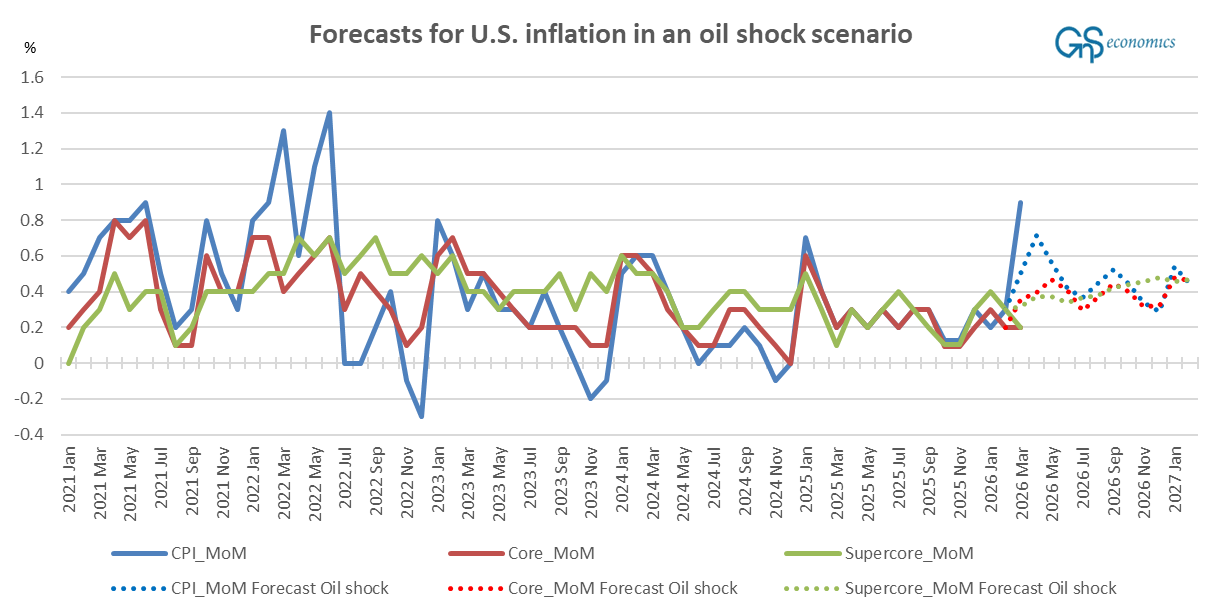
We saw a massive month-over-month jump in the U.S. Consumer Price Index in March. Figure 1 depicts this 0.9% jump and March figures of core inflation and super-core inflation alongside our oil crisis scenario forecasts.
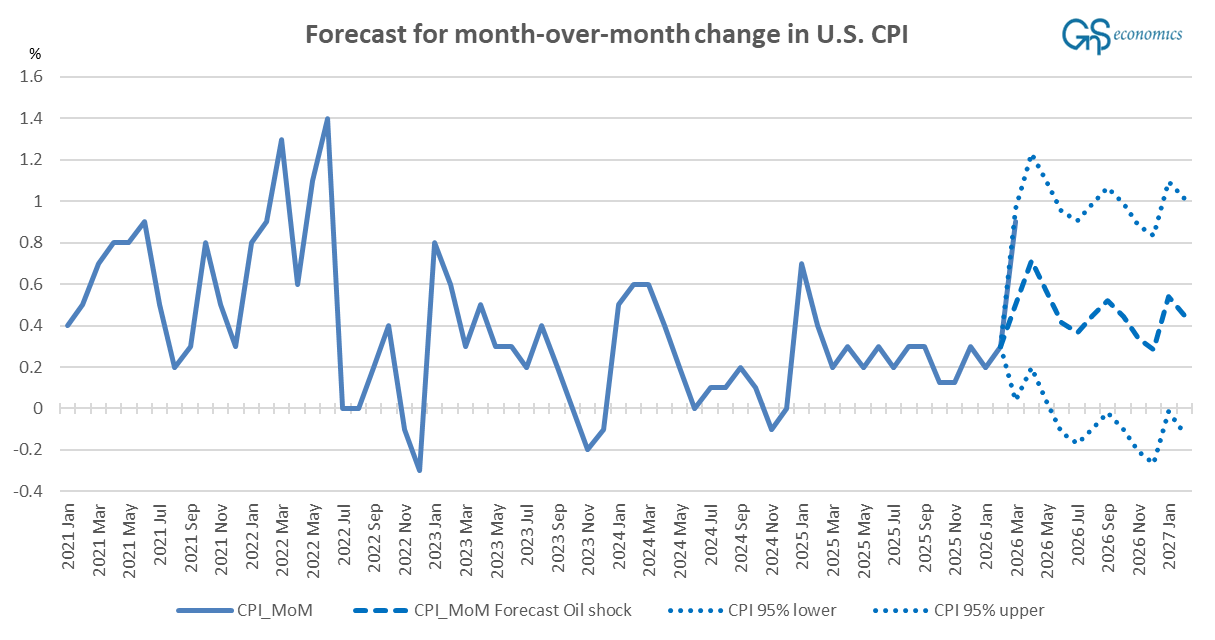
We can safely assert that our modeling structure, assuming just a repetition of the 1970s oil crisis, failed to account for the severity of the current shock. To our defense, the massive 0.9% MoM jump in the CPI did fit within the 95% confidence intervals of our oil shock scenario forecasts (just barely).
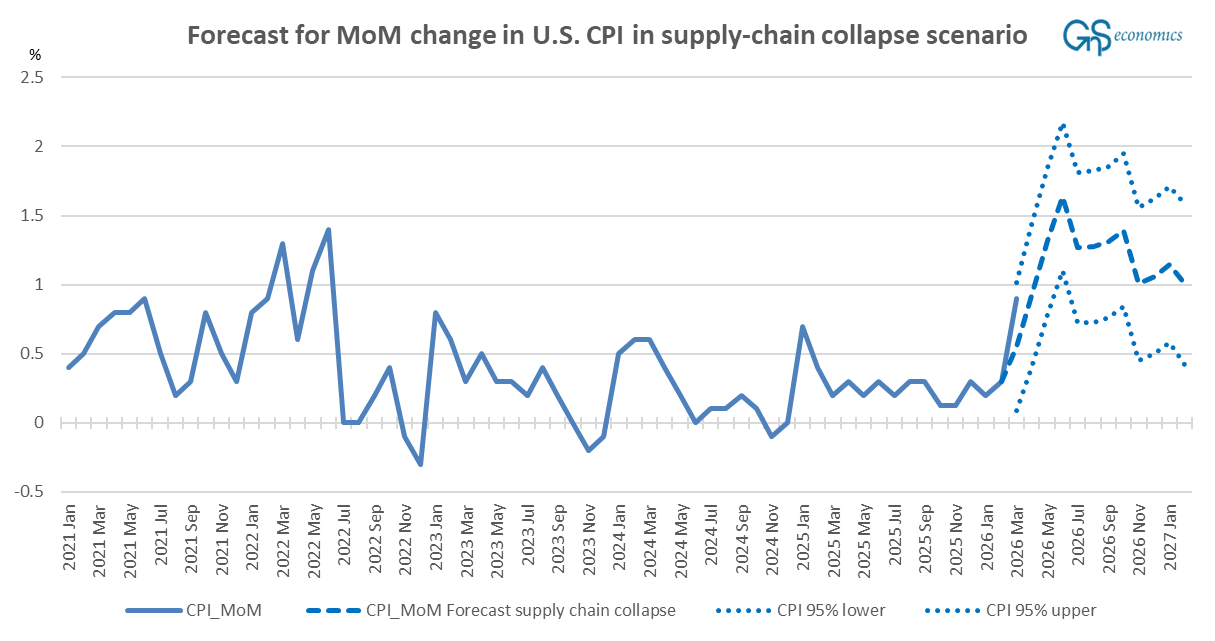
We get much closer of the realized figure of the CPI, when we compare it to our supply chain collapse scenario. Even that scenario was not fully able to account for the massive jump, though, while in this scenario the actualized is safely within the 95% confidence intervals (the point estimate of our scenario forecast for March CPI MoM change was 0.55%).